Sustainability of the Built Environment: New Approaches to Achieving Global Goals
Special Issue • Journal Sustainability (2026) • MDPI • til 2nd June 2026
OPEN FOR SUBMISSIONS

©️Sustainability 2026, MDPI
In the architecture, engineering, and construction sectors, there is growing concern about incorporating measures that align with developing more sustainable projects. This began with the concept of sustainable development, a near-impossible term to define clearly. To ensure a sustainable future, development must evolve to be environmentally responsible, socially equitable, and economically viable, meeting present demands without jeopardising the needs of future generations. In addition to the ongoing need for buildings to achieve the highest possible architectural quality in terms of space design, relationship with place, and urban context, they should also attain energy neutrality, be constructed with minimal environmental impact, and be carbon neutral, amongst other sustainable development aims. Furthermore, architectural design must foster greater flexibility and adaptability to accommodate the evolving requirements of multiple generations coexisting for extended periods.
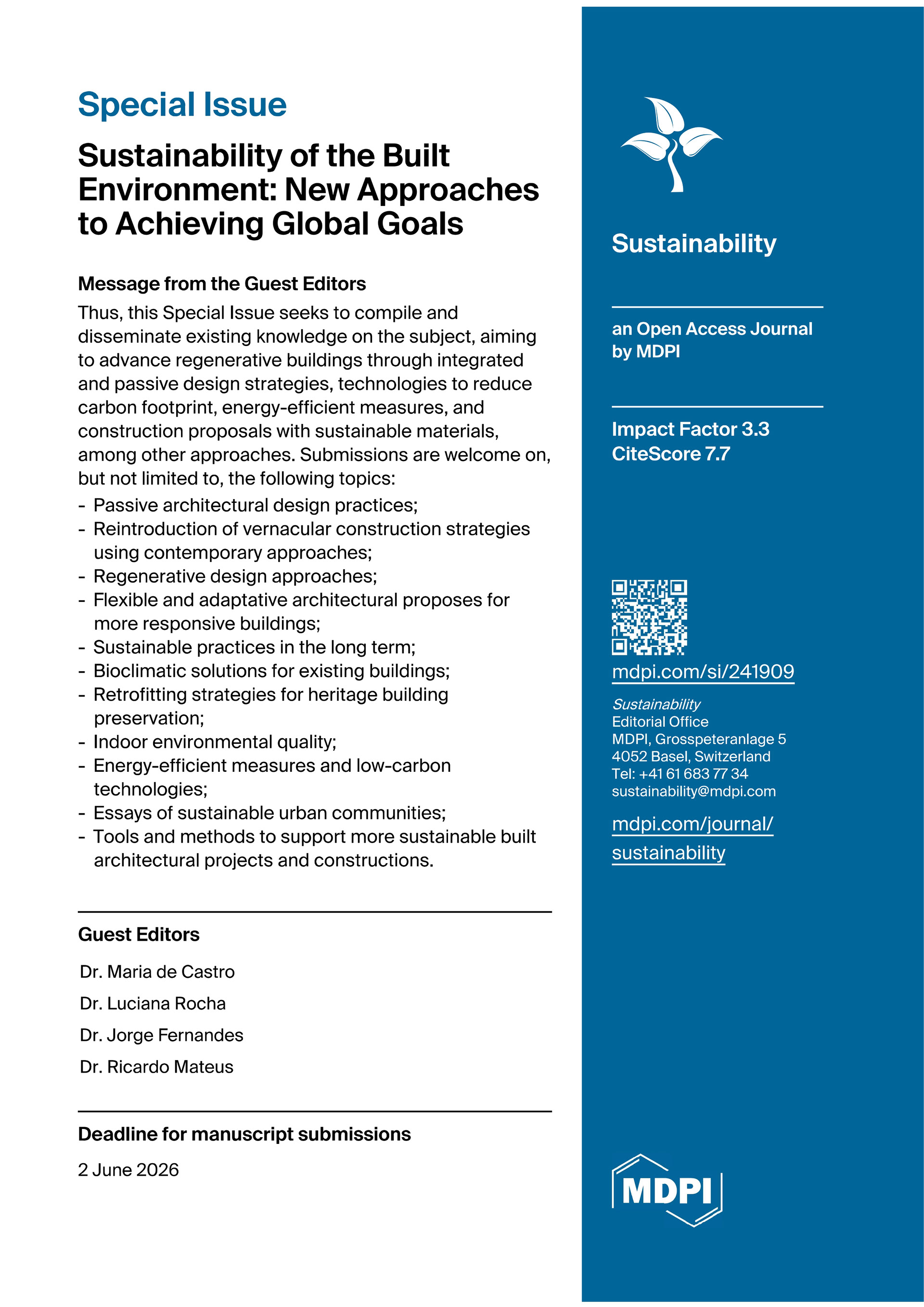
Today’s challenges and goals demand strategies and technologies beyond “sustainable construction” (a concept no longer adequate), focusing on restoration and regeneration to create positive impacts that support the long-term health and evolution of social and ecological systems. So, buildings play a crucial role in applying regenerative principles, as they are among the most significant energy and natural resources users, accounting for a third of global carbon emissions and other substantial environmental impacts throughout their life cycle.Thus, this Special Issue seeks to compile and disseminate existing knowledge on the subject, aiming to advance regenerative buildings through integrated and passive design strategies, technologies to reduce carbon footprint, energy-efficient measures, and construction proposals with sustainable materials, among other approaches.
Submissions are welcome on, but not limited to, the following topics:
⦁ Passive architectural design practices;
⦁ Reintroduction of vernacular construction strategies using contemporary approaches;
⦁ Regenerative design approaches;
⦁ Flexible and adaptative architectural proposes for more responsive buildings;
⦁ Sustainable practices in the long term;
⦁ Bioclimatic solutions for existing buildings;
⦁ Retrofitting strategies for heritage building preservation;
⦁ Indoor environmental quality;
⦁ Energy-efficient measures and low-carbon technologies;
⦁ Essays of sustainable urban communities;
⦁ Tools and methods to support more sustainable built architectural projects and constructions.
Guest Editors
Dr. Maria de Castro
Dr. Luciana Rocha
Dr. Jorge Fernandes
Dr. Ricardo Mateus
For more info click here.
